A strong link between the IPL and the T20 World Cup
Based on statistical evidence*, Mumbai or Bangalore will win the IPL and 11 out of the 16 teams playing in the T20 World Cup have no chance of winning the World Cup.
Here're the damning statistics:
- Mumbai or Bangalore will win the 2010 IPL tournament. The previous 2 editions have been won by Jaipur (league topper) and Hyderabad (4th on the league table).
- The only sides with a reasonable chance of success at the T20 World Cup are Afghanistan, Bangladesh, Ireland, Pakistan and Zimbabwe. The World Cup winning side has never included even a single player who played in the preceding IPL tournament.
- Based on current evidence from IPL tournaments preceding a T20 World Cup (sample size: 1), the top 2 run-getters are usually not good enough (or too old) to even feature in their national side's squad. So, the only consequence of Suresh Raina and Rohit Sharma hitting a real purple (orange?) patch is that they will eventually not play at the 2010 T20 World Cup. The only other real contenders are Herschelle Gibbs and Mahendra Singh Dhoni, but they'd need to score something like 300+ runs across 2 innings to race to the top of the 2010 IPL run-getters list.
- 3 out of the top 5 wicket-takers at an IPL event played in a T20 World Cup that immediately followed. Hence, at least one out of Pragyan Ojha, Amit Mishra and Irfan Pathan will definitely be called up to play at the World Cup. The first one to have a confirmed ticket booking on a trans-Pacific flight, or willing to travel by road, will get the nod.
- West Indies will continue a rich tradition of the hosts (1996 World Cup and 2002 Champions Trophy being examples) never winning a 'World Cup' like event. In much the same manner that the 'home' team has never won an IPL to date.
Labels: indian premier league, ipl 2010, prediction, statistic, twenty20, twenty20 world cup
Thus spake Jagadish @ 11:39 pm | Sledge/Read 1 sledge(s)
Did you like the post? [ Subscribe to the blog feed -
 |
| 

Sloth Sehwag and it is time to ban football in cricket
Sehwag today scored a hundred in 87 balls. For most others, that'd be a rate of scoring which would be hard to surpass. But the problem with Sehwag is that he already has a test hundred where he took only 78 balls - against West Indies in 2006. In fact, he has another 100 made in 87 balls - against Sri Lanka in 2008. So by all yardsticks, this is a crawl from Sehwag.
So far, he has 19 test hundreds. Of those, 5 were scored at a strike rate of 100 or more and 9 were at a strike rate of 80 or more. His "slowest" 100 came off 164 balls (against England in 2002).
For comparison, Adam Gilchrist had 17 test hundreds. Of those, 6 were at a strike rate of 100 or more and 11 were at a strike rate of 80 or more. His slowest 100 came off 160 balls, in the test that Australia nearly screwed up against Bangladesh in 2006.
That's the indication of how merciless Sehwag and Gilchrist have been (and in Sehwag's case, will continue to be) to bowlers.
Around 10 days ago, a few minutes before the start of the first test between South Africa and India at Nagpur, Rohit Sharma was the latest casualty of international cricket teams playing football as part of their warm-up routines.
Now, I don't lay any sort of claim to being a fitness drill expert, but it seems logical that a game like football which is 'physical' in nature is a wrong choice for a warm-up routine, especially just before start of play. You could argue that since the 'games' are played amongst team members, the likelihood of someone doing something stupid is too small. Yet, why take the chance?
In the last couple of years, there have been at least 4 other instances where a warm-up football game resulted in a player (potentially) being out of action.
- James Anderson in March 2008.
- Joe Denly in September 2009.
- Tillakaratne Dilshan in November 2009.
- Muttiah Muralitharan in December 2009.
That's what happened when Brad Haddin was replaced by Graham Manou at Edgbaston last year. Who would determine if the injury is serious? Perhaps the decision needs to be jointly taken by the physio/doctor from the opposition and the ICC match referee.
One way to prevent abuse if the laws are changed is to give the match referee the power to prevent the replacement player from batting, bowling or fielding in case it is subsequently determined that the injury was not severe or was faked.
Why do we need this law change? Injuries are much more commonplace now and can happen at any time during a game. It makes no sense to penalize a team for an unfortunate accident, especially if they find themselves a bowler short.
There have been so many occasions when a bowler has broken down during a game, resulting in the fielding captain being forced to use part-timers or over-use his main bowlers. In Shane Bond's case, that approximately equals the number of innings he has bowled in.
Shane Watson could nick himself badly while shaving, trip over his shoelaces or collide with the pitch roller. Simon Jones twisted his knee at Brisbane in 2002.
It's not just about the bowlers. A batsman could injure himself and the batting captain then has to make do with one less batsman.
Substitutions are par for the course in a lot of other sports. So why shouldn't cricket follow suit? After all, the idea of using substitutes in ODIs has already been trialled and sadly filed for posterity.
Labels: football, icc, india, injury, laws, mcc, playing conditions, rules, sehwag, south africa, statistic
Thus spake Jagadish @ 11:32 pm | Sledge/Read 3 sledge(s)
Did you like the post? [ Subscribe to the blog feed -
|
WICB and WIPA combine to help West Indies set unwanted record
Directly as a result of the farcical WIPA v WICB impasse, West Indies provided Bangladesh its 2nd ever test win a couple of days ago.
Players are totally entitled to receive contracts, but in the absence of these contracts, is industrial action in a sporting scenario the right option? It is not as though the West Indies players were blameless. They didn't have contracts because they refused to sign the contracts that the WICB offered. Did the WICB offer favourable terms? Perhaps not. As it is, West Indies cricket has suffered majorly in the past couple of years with sponsors pulling out.
Would Digicel, the current sponsor, have had the right to demand that the WICB field a XI that would enhance the Digicel brand? Wouldn't Digicel's contract with the WICB have referred to WICB attempting to/ensure that the best players turned out for the West Indies? It's quite obvious that Digicel wouldn't like to have been associated with a side led by Floyd Reifer, who got a birthday present in the form of the captaincy a couple of weeks before his 37th birthday. It's like England naming Ian Ward or Aftab Habib captain and India naming Vijay Bharadwaj skipper. Of course, one thing is for sure - captaincy has a positive impact on Reifer's batting. His batting average went up by a whopping 36% (7.87 to 10.7).
The reality is that regardless of the result of the game, no side would have "won" or proved anything. Had West Indies' B side beaten Bangladesh, it would have told us that Bangladesh aren't even good enough to beat a second string WI XI. Now that Bangladesh have won, as a corollary, it implies that West Indies cricket is so much lacking in depth that a 2nd XI loses to Bangladesh. I suspect with the exception of perhaps New Zealand, every other country's 2nd XI should be able to beat Bangladesh.
As a result of the feud between the cricket board and the players, the test had 9 debutants (7 for West Indies, 2 for Bangladesh) and this is the first time since 1961 that 9 or more players have debuted in a test that wasn't the first test played by a country (or the first one played after a prolonged break).
Bangladesh v India in 2000 had 14 debuts, Zimbabwe v India in 1992 had 10 debuts (all the Zimbabwe players except Traicos), West Indies v South Africa in 1992 had 13 debuts (South Africa's first test after re-admission) and Sri Lanka v England in 1982 had 12 debuts. Most of the other games that had a lot of debuts were those played shortly after World War II.
Labels: bangladesh, contracts, debut, industrial action, statistic, strike, west indies, wicb, wipa
Thus spake Jagadish @ 11:34 pm | Sledge/Read 2 sledge(s)
Did you like the post? [ Subscribe to the blog feed -
|
Close, but no cigar
While it is tempting to think that England's last wicket pair's efforts to draw the Cardiff Ashes test represent a rare feat, the reality is that it has happened three times already in 2009! As this post is being written, it seems like the West Indies "B" v Bangladesh test at St. Vincent is also heading to a closely fought draw. West Indies "B" need to get 122 runs more to win, but have only 3 wickets in hand!
In fact, there were two instances in the same series (England's tour of West Indies). At Antigua and Trinidad, West Indies managed to squeeze out a draw. The third instance was New Zealand against India.
Some other recent tests where a side had already lost 7 wickets and still managed to salvage a draw (criteria being an end-of-game lead <= 50) include Pakistan escaping at Bangalore in 2007, India escaping at Lord's in 2007, West Indies escaping (against India, twice in the same 2006 series - what's it with close draws and West Indies?!) at St. Lucia and Antigua and Australia drawing at Old Trafford the 2005 Ashes.
After the Antigua test of 2006, I wrote about other similar close tests.
However, the interesting part is that out of the 84 "they gutsed it out for a draw" results in test cricket so far, over 30 have been in the last 20 years.
Is it an indicator that it is increasingly becoming easier for tailenders to bat out time? Is it because pitches don't quite start rapidly helping bowlers later on in the game? Is it because umpires nowadays tend to be more cautious when it comes to lightmeter readings? Do umpires not clamp down on ruthlessly enough on obvious time-wasting tactics? Is it about bowlers taking their batting lessons seriously?
I suspect the answer is 'All of the above'.
Then again, if you just looked at the 1960s, 1970s or 1980s, there were 16, 12 & 13 tests across those decades. So maybe there is no pattern there. The number of instances prior to the 1960s is low because the number of countries that played tests then is so low.
Pakistan started out in test cricket in the 1950s while India & New Zealand started playing more regularly from that decade and they got reasonably competitive from the 1960s. I think that explains the spurt in close draws from the 1960s. In addition, the other sides like Australia, West Indies, South Africa and England were also fairly well balanced and that would also have increased the number of close games.
Labels: ashes, ashes 2009, close finishes, statistic
Thus spake Jagadish @ 1:28 am | Sledge/Read 2 sledge(s)
Did you like the post? [ Subscribe to the blog feed -
|
Should test matches be reduced to four days?
A couple of weeks ago, in an interview to India Today, ICC President David Morgan indicated that reducing test matches to being 4-day affairs was on the agenda.
Q: Other than merely re-emphasising its importance, what is being done on the ground to restrengthen Test cricket?Let's examine if there is any evidence to support the ICC's stand. I took all tests that had been played after 1 Jan 2006 and excluded games involving Zimbabwe & Bangladesh. That's a total of 123 games. Surely that's a decent sample set. Then I excluded the Antigua farce and the terror-impacted Lahore test.
Another thought that many people have, that we are examining is whether Test match cricket can be played over four days rather than five.
Q: How quickly will we see a four-day Test? Has the mental shift been made?
The mental shift has been made in that it has been talked about and examined, I think that has already occoured. I would be very surprised if within a year you haven't seen some significant changes in Test match cricket. Over rates, pitches, daynight Test cricket … I think in a year's time you will see for yourself changes that have occoured in Test match cricket.
So now I had 121 tests and here're the results expressed in average duration of the test.
- The average duration of a game with a result (draws are 5-day affairs since the Antigua & Lahore tests have been excluded) has ranged between 4.2 and 4.4 days. It was 4.3 in 2006, 4.4 in 2007 & 2008 and 4.2 in 2009 [so far].
- West Indies and Pakistan win in the shortest period (average of 4 days), but that data is skewed because they've only won 2 & 5 tests respectively in the time period chosen. Among teams with at least 10 test wins, South Africa get things done in the shortest time - 4.1 days.
- The shortest tests also happen in South Africa, lasting 4.2 days on an average. Both these stats indicate that South Africa have been quite ruthless over the past 3.5 years.
- Australia have
surprisinglytaken the most time to win overall (4.6 days) and the number is identical for home games.
The evidence does seem to suggest that more and more tests are getting over in around 4-4.5 days. So while David Morgan may not be quite right about getting to 4 day tests within the next year, I see it happening after the next 2-3 years for sure. Hopefully the changes include imposing overs restrictions on test innings, including giving toss-winning teams the option to pick the overs limit for their 1st and 2nd innings.
Of course, less than 4 years ago, this same ICC, in their infinite wisdom, staged a six day test! After the dreary draws at Lahore and
In other news, John Buchanan's comments in his soon-to-be-released book which focusses on the Twenty20 game, have
Adam Gilchrist's autobiography, "True Colours: My Life", is to be released next week. As is to be expected, and as we've seen with cricketer autobiographies (Trescothick, Pietersen, Wright, Fletcher, Flintoff, Hussain or Lehmann), there is a tendency to selectively leak 'scandalous' portions of the book. The aim is to create a buzz around it, with the hope that it translates into more sales when the book is released.Personally, I've never had a great opinion of Buchanan. He's said enough stupid things (blaming losing opponents for his bowlers not executing their skills & predicting that Australia's 2007 World Cup side would have ambidextrous cricketers, just to take a couple of examples). If he really does point out in the book that Tendulkar, Dravid, Ganguly & Laxman aren't suited to Twenty20 cricket, then is that necessarily a wrong thing to say? In any case, none of them play Twenty20 internationals anymore (Tendulkar is the only one to have played a T20 international) and Laxman probably sat out all of the 2009 IPL edition.
Adam Gilchrist's revelations about Tendulkar are nothing but just that. He has his point of view, and others have theirs. Its his autobiography, and he has a right to choose what to say, and what not to say. If he reckons that the best way to sell his book, when there's an Australia v India series on, is to say things about India's cricketers that rile their fans, then that's his judgement.
I wrote before the BCCI announced the 2007 Twenty20 World Cup squad that Dravid & Ganguly shouldn't be in the squad while I was ambivalent about Tendulkar. If I had to arrange the 4 batsmen in decreasing order of ability in Twenty20, the order would be Tendulkar, Dravid, Ganguly and Laxman. So exactly what's new about what Buchanan says? Is the outrage based on "How dare this foreigner tell us our greats aren't good enough at T20!"?
I'm guessing everyone who is outraged actually thinks the same way about Laxman and a lot of people would feel so about Ganguly & Dravid. The only questionable comment is about Tendulkar, and given he averaged 31 (strike rate 106) and 33 (strike rate 120) in the 2008 & 2009 editions of the Indian Premier League, there's enough evidence to suggest Buchanan is right! In any case, I haven't read the book, so I really can't comment on other issues.
Today at Cardiff, the venue for the first Ashes test, Ricky Ponting became the 2nd fastest to reach 11000 test runs, taking 9 innings more than Lara and one less than Tendulkar. Next in his sights - going past Border's Australian record of 11174. After that, he'll go on and get the test runs and centuries records for sure, unless injury strikes him down or he gets totally demotivated after being dismissed 8 times by Graeme Swann in this series.
Last week, India won the ODIs in West Indies to notch up 5 consecutive series wins. I was curious to find out other similar streaks and here's what I found.But the runaway victor in this category is Australia with a whopping 10 consecutive series wins between Dec 2002 and Sep 2004, including an unbeaten 2003 World Cup campaign.
I could have probably excluded series where there were lesser than 3 ODIs. But I couldn't have excluded series involving the minnow teams because they turn up at the various World Cup-like events. Even then, I don't think the results will differ too much from the ones above.
Labels: 11000, ashes, ashes 2009, autobiography, buchanan, innovation, ponting, statistic, streak, test cricket
Thus spake Jagadish @ 11:47 pm | Sledge/Read 1 sledge(s)
Did you like the post? [ Subscribe to the blog feed -
|
Priceless!
Even if VISA is one of the 'commercial partners' of the T20 World Cup, to heck with ambush marketing.
Tickets to the game: Not applicable
Food & drink: Not applicable
Watching (on TV) Ricky Ponting play a dumb shot off Mendis: Worth being awake at past 1 am
The look on Ricky Ponting's face as his dream fades: Priceless!
It is my firm belief that England should just withdraw from the competition so that the Ashes series can begin a week or so ahead of schedule.
This is only the
Labels: australia, statistic, twenty20 world cup
Thus spake Jagadish @ 12:09 pm | Sledge/Read 4 sledge(s)
Did you like the post? [ Subscribe to the blog feed -
|
Where's the ruthlessness?
It is now a week since India won the test series against New Zealand 1-0. Yet, as has already been commented in a lot of places, the scoreline should really have been 2-0.
In just 7 tests as India's captain (won 5, drawn 2), MS Dhoni has already twice exhibited a strangely defensive mindset. First, at Mohali against England where the batting was needlessly defensive in the 1st innings and and an unnecessary and unhealthy focus on seeing if Gambhir and Yuvraj could get their centuries in the 2nd innings.
At Wellington, I don't think the declaration was significantly delayed. I know setting a target of 600+ in the last innings is a bit outlandish, but at least the positive intent was there while batting. The main problem is that the field setting during New Zealand's "chase" was ridiculously defensive a lot of the time, particularly after McCullum was wrongly given out.
For some strange reason, Daniel Vettori was allowed to pick up singles. Now, he's not a bad batsman and but for the need to preserve the image of New Zealand's "batsmen" he'd have consistently gone in at #5 or #6. Yet, given the state of the game and the immense pressure he'd have been under, there was a real shortage of close-in fielders. This tendency to "allow" the "better" lower order batsman to get off strike with the intention of focussing on the bunny at the other end is something I've seen several Indian teams employ. I dare say, it has failed every single time, for a variety of reasons (poor field placement, dropped catches, bad fielding, plain luck, etc.)
The ruthlessness that you expect from a side which targets a #1 position in ODIs by 2009 and in tests by 2010 (incidentally the very first time that a short-term vision is being outlined by someone representing the BCCI) has been absent for a while.
One could point out that South Africa lost the Sydney test while Australia lost at Cape Town. After all, if the other top two sides also seem to take it easy in "dead rubbers", why blame India?
Yet, why should the Indian team use the current Australian team as benchmark? Why not set new standards?
In the 18 series that Dhoni has captained, India have lost the final match after sealing the series on 4 occasions (v Pakistan in India, v Sri Lanka away twice and the recent ODI series v New Zealand). Add in the diffidence at Mohali and Wellington and you have to question if the team management is satisfied being a #3 side or if it really wants to be #1 soon.
There is absolutely no doubt that the side has the ability to do even better. What it does need though is someone other than Yuvraj at #6. Yuvraj is 27 while the others vying for the slot (Suresh Raina, Subramaniam Badrinath & Rohit Sharma) are 22, 28 and 25. In fact, if Irfan Pathan sorts out his bowling soon enough, I'd add him to the mix as well. After Sourav Ganguly's retirement, none of the top 6 bowl anything other than spin (excluding Tendulkar's all-sorts). So Irfan would provide a wonderful option. He can't bat worse than Yuvraj, so all he has to do is to get the bowling together and contribute something like 15-5-35-1 (with the occasional 2-3 wicket "haul") every innings as a 3rd seamer. That would be invaluable.
So really there's nothing to be lost in giving these chaps a few chances. I wouldn't associate any stigma with Yuvraj Singh not being able to make it in test cricket. He is one of the best batsmen in limited overs cricket. He has had enough opportunities, and I'll stick to my stand. He is an excellent replacement batsman, but he should never be a first choice pick despite him playing the odd sensational innings.
For all the talk of Michael Bevan not succeeding in test cricket, I think it suffices to point out his ODI record and the number of times he's won a game for Australia. There're several other players who come to mind - notably Symonds and Rhodes (batting & fielding) & Harris and Saqlain (bowling). Does that diminish their achievements? I don't think so. I'm not devaluing test cricket. But assuming that achievements in test cricket count significantly more than those in the other formats of the game is unfair.
A statistic to end this - Before this series win, the last time India won the test and ODI series of a tour (excluding those involving Bangladesh & Zimbabwe) was in Pakistan in 2004. If you exclude the sub-continent, the last occasion was in England in 1986.
Labels: dhoni, india, new zealand, positive intent, ruthlessness, statistic, yuvraj
Thus spake Jagadish @ 11:12 pm | Sledge/Read 2 sledge(s)
Did you like the post? [ Subscribe to the blog feed -
|
Woeful defensive England
West Indies have won their first series against half-decent opposition since beating India in 2002. They came pretty close to losing the final test, and were 8 down when the game ended. It'd have been very interesting if there was a situation where having exhausted the 2 reviews available to them, they couldn't appeal for (say) a plumb lbw that wasn't given in their favour. This was a situation I outlined in a post after the ICC announced that teams would now only get 2 reviews rather than the previous 3.
Imagine if the test match or series was up for grabs, with the last pair at the crease and an appeal for lbw was made, but the umpire ruled not out even though it was quite plumb. The bowling team finds to its agony that it has exhausted all its reviews. The batsmen go on to save/win the test. I'm guessing that it isn't an altogether unlikely scenario. So why should a team be penalized for using up its reviews even as an umpire getting it wrong totally costs them a test/series?There's a lot of talk around West Indies being defensive by filling the side with batsmen & picking only 3 bowlers for the last test and preparing dead pitches. There's no doubt that the ICC needs to do something about the pitches. But if anything, England were defensive yesterday and showed no positive intent.
I actually expected England to declare before lunch, immediately after Pietersen had got his century. But bizarrely, they kept batting for around 10 more balls. Could those extra balls have made a difference? Entirely likely!
In fact, when Prior got out, Pietersen was on 80-odd and apparently had issues with the instructions that were relayed to him. Maybe the lure of a personal landmark clouded his judgement. I'm surprised he didn't rewind to just 3 months ago when he was England's skipper enjoying India bizarrely & defensively focussing on Gambhir and Yuvraj getting centuries at the cost of winning the Mohali test.
England made 3 scores of 500 or more in the series against West Indies. It's quite possible this is the first time this has resulted in a series loss.
Labels: england, positive intent, statistic, west indies
Thus spake Jagadish @ 1:58 pm | Sledge/Read 2 sledge(s)
Did you like the post? [ Subscribe to the blog feed -
|
Younis Khan makes yet another 250
Younis Khan, the Pakistan captain as of 3.50 pm IST on 24 Feb 2009, is now the 10th player to make multiple scores of 250 or above. The astounding bit about that list is that Don Bradman, in making 5 scores of 250 or more, hit two sixes while Graeme Smith didn't hit a single six!
Pakistan have made nearly ~ 500 so far and have avoided the follow-on. Since it has been clear for the past couple of days that on that pitch even Pommie Mbangwa & Chris Martin would have scored in double digits, I tried to find out which country's pitches were the most batting friendly.
So I took tests from the last 5 years where the team batting second made 400+ and either had a slim lead (< 50) or were trailing big time (thereby implying that the team that batted first had made something like 550-600). There were a total of 35 instances, out of which 15 were drawn games.
Tests played in England and India contribute 7 instances while Australia and Pakistan have 6 each. The number of tests played in that period in the 4 countries was 35 (England), 30 (Australia), 27 (India) & 17 (Pakistan). This implies that Pakistan has a much higher frequency (35%) of dull dreary tests where the first innings of both teams result in huge scores. The frequencies for the other countries are India - 26%, England and Australia - 20% each.
I guess over the first couple of days of this test, Pakistan's cricketers (& fans) would have been wondering about the need to play tests because after all, if you if you don't play, you can't concede 600+!
Update: Sri Lanka's first innings total of 644 is the highest total to have been overtaken in a test. The previous highest was 588, jointly held by South Africa at Antigua in 2005 (Gayle scored a triple) and Pakistan at Faisalabad in 2006 (Dhoni and Irfan Pathan saving face for India).
Labels: pakistan, statistic, younis khan
Thus spake Jagadish @ 12:17 pm | Sledge/Read 0 sledge(s)
Did you like the post? [ Subscribe to the blog feed -
|
Triple role Tillakaratne
Tillakaratne Dilshan will captain, keep and open in today's T20 game against India.
If he doesn't trip over a teammate's lengthy name, like Hettiarachchi Gamage Jeevantha Mahesh Kulatunga, he will become the third player, after Gilchrist & McCullum to have played a triple role in a T20 international.
In fact, there have only been 7 other players across 132 years of tests, 38 years of ODIs & 3 years of T20 internationals to have opened, captained and kept wickets in a game.
Labels: dilshan, sri lanka, statistic
Thus spake Jagadish @ 3:20 pm | Sledge/Read 2 sledge(s)
Did you like the post? [ Subscribe to the blog feed -
|
India wins 9 ODIs in a row
The Indian ODI side, after ODI series wins away last year in Australia & Sri Lanka and at home against England, now has a 5-0 clean sweep in its sights in Sri Lanka.
They've now won 9 ODIs in a row, 1 more than previous streaks of 8 - 1985, 2003 during the World Cup & 2006 in a thrashing of England. The interesting aspect is that all these sequences either started or ended in February!
The Indian media has gone overboard in describing the team as the #1 side, conveniently forgetting that Sri Lanka is ranked #7 while South Africa beat the incumbent #1, Australia. There is no doubt that this side has immense potential. The batting is very good and has a great blend of aggression (Gambhir, Sehwag, Yuvraj, Raina & Yusuf Pathan) & solidity (Tendulkar, Dhoni - depending on his mood & Rohit). The bowling has also been impressive & the new-ball bowlers (Zaheer, Ishant & Praveen) have picked up top order wickets repeatedly. Harbhajan's absence has given Pragyan Ojha the scope to display his ability and also put more responsibility on Sehwag, Yusuf Pathan & Yuvraj. The fielding is very good (Yuvraj, Raina, Rohit, Yusuf Pathan & even Ishant Sharma).
Yet, could it be a false dawn? After all, the personnel were fairly similar during the Dravid-Chappell years where India's ODI side promised so much in terms of fielding, flexibility of batting order & bowling. Yet, within a year, the team had more or less lost the 'zing' when "seniors" were restored, thus driving up the age & bringing down the fielding & running-between-wickets.
At least this time it is inconceivable that the personnel will change significantly. What could change is how the team responds to losing. Starting from the Australia tri-series, the side has won 20 out of 28 games against decent opposition (including England is a stretch of the term 'decent', admittedly!).
The toss hasn't played too significant a role - 15 tosses won, 13 lost. Out of those 15 games where India won the toss, 3 games were lost. Out of the 13 tosses lost, 8 games were won. Out of the 13 games where the side batted first, it won 10. Out of the 15 times it chased, it won 10. Not a very significant difference.
Yet, the elation must be tempered with the reality that after the Australia tri-series, the wins have all been in the sub-continent. Yes, the team can't really help that since that's how the scheduling is. That is why it is so crucial to win the ODIs against New Zealand.
Labels: india, sri lanka, statistic, streak
Thus spake Jagadish @ 12:37 am | Sledge/Read 0 sledge(s)
Did you like the post? [ Subscribe to the blog feed -
|
ICC ratings in 2008 - the gainers and the losers
While the way the ICC rankings work will be as much an unknown commodity as the Duckworth-Lewis tables, they are a reasonable pointer to the way a team performed across a slightly larger time period - say a year.
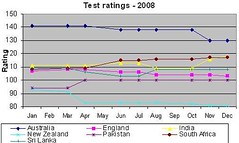
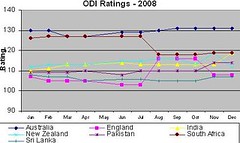
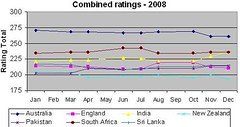
Using the test and odi rankings list for 2008, I charted out the performances of the top 7 teams (Australia, England, India, New Zealand, Pakistan, South Africa & Sri Lanka). The results are interesting.
See the test ratings graph below. New Zealand & Australia are the biggest losers in terms of rating points (nearly 13% down for New Zealand & 8% for Australia) in December compared to January. South Africa (8.3%) is the biggest gainer, obviously because of their performances away, in India, England and Australia.
Pakistan (6.4%) is a gainer despite not playing a single test during the year! Go figure! Ignoring Pakistan's gain, India (6.3%) were the 2nd biggest story of the year, and (again) deservedly so since they beat Australia and England.
From the odi ratings graph below, India are the biggest gainers (8%) followed by Pakistan (4.6%). How is it that South Africa are #2 despite actually falling in rankings significantly (5.6%)? I'd say its because positions 2-7 are much more clustered together now (December) compared with at the start of the year. The other teams were neglibibly positive or negative in the rating change.
The combined ratings (a simple addition of the test & odi ratings) in the graph below indicates that if you take tests and odis as a whole, India are the team of the year (14.5% increase) while New Zealand's dip (13%) is a major cause for concern. Australia had a nearly 4% dip while Pakistan's numbers are artificially boosted by the test rating.
Labels: icc, rankings, statistic
Thus spake Jagadish @ 2:11 am | Sledge/Read 11 sledge(s)
Did you like the post? [ Subscribe to the blog feed -
|
South Africa do what was unthinkable a year ago
The inevitable happened. India've kept huffing & puffing at Australia for the better part of the last decade, and eventually the house fell, not to India but to South Africa, who became the first team in nearly 16 years to win a test series in Australia.
In fact, South Africa are the first non-Indian team to have defeated Australia 2 tests in a row in the last 18 years. The West Indians in 1993 & 1999 and the East Indians in 1998 & 2001 were the only sides to have done it.
South Africa have played brilliantly and it has been a total team effort - its tough to pick the top performers from Steyn, Smith, Duminy, de Villiers, Kallis & Amla. Essentially though, Australia's weakness against good quality swing bowling has been shown up yet again. It was the case in 2003/4 against India, 2005 against England, 2007/8 against India, 2008/9 against India and now against South Africa. Maybe its something to do with the batting technique or just the attacking instinct. Australia better get its act together on countering swing bowling, because now that the formula is out there, more teams will use it hoping for success, sometimes without having the quality of resources.
I have no sympathy for Australia though. The side and the cricketing establishment have been in denial mode ever since the defeat in India, and especially after thrashing New Zealand. Over rate problems? Let's blame the sightscreens and talk of maintaining the spirit of the game when a series was at stake. Lee's "performances"? Let's blame his breakup. Hayden in terrible form? Let's talk of poor umpiring decisions & run outs (as if he wasn't responsible for the runouts!). No spinners? Let's say they're young & inexperienced when they've had 15 years to groom someone to take over from Warne.
The first thing Australia's selectors need to do is to drop Hayden. His batting has been hopeless. It's not just that - he doesn't even look like he wants to be out there batting! In fact he wants to get off the strike so often - maybe thats what's got him run out twice in the last few tests! I've always thought he was over-rated. Among the top run-getters since 1 Jan 1990, only 2 batsmen (Mark Waugh & Alec Stewart) have worse away batting averages. Hayden averages 42.7 outside Australia compared with 58.4 at home. It's quite obvious he's a home town bully. He doesn't deserve to be rated amongst the modern greats, let alone the all-time greats!
The second thing Australia's selectors need to do is to pick a new captain. I just think they have a hopeless moron as captain right now. Ponting's captaincy has been 'moronic' in my books right from the time he sent England (0-1 down) in on a superb batting wicket at Edgbaston in 2005 minutes after McGrath had been ruled out of the test (& possibly the series). His subsequent acts (Nagpur, for e.g.) merely confirmed the belief.
Despite South Africa's series win, in my opinion Australia are #1 until the time they actually lose home and away. India can't claim the #1 spot because after all, they didn't win in Australia. I'd say that the return series against South Africa & the 2009 Ashes will give a fair indication of whether Australia will remain #1 or not.
Think about it - despite losing Langer, Warne, McGrath & Gilchrist in the span of a year, they've more than managed to hold their own most of the time. I know that isn't a great benchmark for #1, but you do need to give weightage to the quality of personnel lost. India're bound to go down that road sometime in the next 2 years and we'll eagerly see if the batting holds up.
Labels: australia, india, rankings, south africa, statistic
Thus spake Jagadish @ 11:45 pm | Sledge/Read 10 sledge(s)
Did you like the post? [ Subscribe to the blog feed -
|
Sehwag's achievement and a test team missing in action
I just realized that Sehwag, in 2008, has scored a triple century (Chennai v South Africa) and a double century (Galle v Sri Lanka). I reckoned this would be a pretty rare occurence.
Turns out that this has only happened thrice in test cricket's 131 year history, and the previous time it happened was way back in 1933. At least one of the names is fairly predictable.
In the 1930 Ashes, i.e. in a single series, Bradman had two double centuries and a triple century! Similarly, in the 1933 series against a very weak New Zealand, Wally Hammond had a double century and a triple hundred.
Honourable mention for Sanath Jayasuriya, who hit 340 and 199 in Sri Lanka's home series against India in 1997.
Ganesh asked me an interesting question: When was the last time one of the main 8 test-playing countries (i.e. excluding Bangladesh & Zimbabwe) didn't play a test? Actually, let's extend that question to asking when was the last year (before this year - Pakistan haven't played a test in 2008) a team was eligible to play tests and still didn't play a single test.
Since Zimbabwe haven't played a test for 3 years now, let's exclude them. Using Statsguru, it seems like the answer is 1970. In 2000, Bangladesh were not yet a test side (and are still not!). In 1991, South Africa were not yet back. In 1981, Sri Lanka were not yet a test side.
Exactly what happened in 1970? Only 3 teams played test cricket then - Australia, England & South Africa!
That was the year South Africa were suspended from international cricket because of the apartheid policy adopted by the government of the day. What happened to the other teams? Why didn't India, New Zealand, Pakistan and West Indies play a single test that entire year?
Labels: india, sehwag, statistic
Thus spake Jagadish @ 8:37 pm | Sledge/Read 5 sledge(s)
Did you like the post? [ Subscribe to the blog feed -
|
What a series, pity about the pitches though!
A fantastic series came to an end with India winning at Nagpur to win the series 2-0 and bring back the Border-Gavaskar Trophy after 4 years.
Like I wrote fairly early on, partnerships at the top and the bottom proved to be crucial. Five out of the 50+ run partnerships for the first wicket were by India's openers. Right from around the time Harbhajan & Zaheer put on 80 at Bangalore, the momentum switched to India. Australia's woes got compounded with the Harbhajan-Dhoni partnership in India's final batting dig of the series.
Barring a couple of sessions here and there, the momentum stayed with the home team. India won most of the crucial sessions. Amazingly enough for a side as good as Australia, far too often they eased up the pressure when they had India by the unmentionables.
Is that an indicator of the quality of personnel on either side, the captaincy, luck, pluck, or a shift in on-field power equations? I'd still say that Australia started the series as favourites. But a lot of their personnel misfired at the same time. With the exception of Mike Hussey & Simon Katich, there was no consistency in the batting. Matthew Hayden, Michael Clarke & Ricky Ponting fired only once or twice all series. In the case of the bowling, it was worse. Brett Lee & Stuart Clark just didn't turn up (strike rates of 111 & 219) and Johnson's numbers were hardly a true reflection of how ineffective he really was.
The fairytale story of Jason Krejza hid a very obvious problem: Australia thought they'd be better off playing Cameron White as a second all-rounder, and they got what they wanted (some decent stands with the lower order, but precious little with the ball). It was bloody obvious to most folks that White really shouldn't have played after Mohali (3/120 in 27 overs in the game on a pitch that helped spin). Yet, Ponting & the selectors persisted with him. Krejza was thrown in to the deep end when there was nothing to lose, and he showed White how to purchase his wickets. There'll surely be more innings when Krejza bowls far better for worse returns, but his out-of-the-blue performance should give Australia some hope for the future.
Several questions can be asked about Ricky Ponting's captaincy, for worrying about the opposition when he had enough issues on his plate such as team selection, consistently calling heads despite it not working out for two tests in a row, the field placements which meant Gambhir & Sehwag scored at will in the second test, prioritizing speeding up the over rate above breaking partnerships for the third time in the last 10 months, etc.
For all the pre-series talk of 'new age cricket', in terms of %age of runs scored in of their runs in 1s, 2s & 3s, the numbers were 49% for Australia & 53% for India. Even better, India's run rate when it came to scoring 1s, 2s & 3s was 1.85 an over while Australia's was 1.46 an over. Both teams were even when it came to the run rate for boundaries and sixes - India's was 24.47 an over while Australia's was 24.37.
Realistically, the only gains for Australia from this series have been, in descending order of an index (expectation + impact): Krejza, Hussey, Watson, Katich & Siddle. As a team, they have regressed. If it weren't for Clarke himself having a bad time, the knives would normally have been out for Ponting. Unless of course, the Aussie selectors want to take a bet on making Hussey captain. Australia's upcoming series against New Zealand & South Africa provide great opportunities for easing out Hayden from the opener's slot, given that Jaques & Marsh are waiting in the ranks. We could also see Andrew Symonds returning, thus giving Australia a better middle-order and an extra spin bowling option.
Yet, it isn't a case of all being hunky-dory for India. The fact that they won without two of the bulwarks (Kumble & Dravid) performing is an indicator of the depth available and the good form that the rest of the players were in. Kumble has now retired, but questions will be asked about how hungry Rahul Dravid is to get his batting (and amazingly enough, his slip catching) sorted out before the tests against England.
India's biggest gains from the series have been Dhoni's refreshing captaincy & his beginner's luck, the batting form of Gambhir, Sehwag, Tendulkar & Laxman, Ganguly & Kumble retiring with able replacements in the wings (Ganguly's middle order replacement is as yet undecided, with Badrinath, Rohit Sharma, Yuvraj Singh & Suresh Raina being the contenders) and the pace bowling department whose bench strength (Sreesanth, Munaf, RP Singh) is fairly impressive.
Australia losing this series doesn't mean they're not the best side. They obviously are, and do have the ability to stay there for a while. India have just reinforced the fact that they've caused Australia the most troubles over the past 8-10 years. It is going to be a fascinating battle between India, South Africa, England & Sri Lanka for the bragging rights to be called Australia's replacement if Australia do slip up majorly over the next year or two.
The main problems though are with the BCCI. Sparse crowds & slow pitches do not help the cause of test cricket at all. India has hosted the highest number, and highest percentage, of drawn games in the last five years. Overall, I think the series mostly sucked, in the context of the quality of cricket played. The placid pitches meant the play was mostly defensive in nature, and most of the time that strategy didn't work.
How much more interesting would this series have been had the pitches aided bowlers just a tad more than they eventually did? How much more enjoyable would the series have been for fans had they got access to (far flung) stadiums at reasonable rates without having to pay through their nose for five day tickets? Given that the bulk of the revenue for host associations in India comes from the sale of advertisement hoardings etc. at the stadium, they should just set rock-bottom prices to entice more spectators. It was ridiculous that when Tendulkar got past Lara and Sourav Ganguly made his last bow (only the Englishmen Billy Griffith & John Hampshire have scored a century in their debut innings and a duck in their last), there was just about enough of a crowd for it to be called a half-full (or is that half-empty?) house.
Here are a few statistical indicators of how huge this series win is: Australia have lost only 4 series in the last decade. Australia's two worst test defeats in the last decade came in this series and this was the first time in nearly a quarter of a century that Australia failed to win a single test in a series of 4 or more matches.
Update: I have this nagging feeling Australia have got away with it yet again with a fine of 20% for Ponting & 10% for the rest of the folks. This is the third time in 2008 that Australia is being fined for a slow over rate.
It happened in the Perth test against India and then during the triangular one-day series game at Sydney.
Penalties for over rates are level 1 offences. As per the 'Guidelines for Offences' section of the code of conduct, a repeat of a level 1 offence within 12 months would upgrade the new offense to a level 2 offence, which carries a penalty of 50-100% of the match fee and/or a 1 test/2 ODI ban. Has the ICC's database conveniently broken down again, like it did when Judge Hansen was not made aware of Harbhajan's history? The two penalties I mentioned above aren't even listed on the list of breaches & penalties in 2008 on the ICC's website. Go figure!
It seems to me that Ponting was scared of a test/ODI ban and that's why he used part-timers to speed up the over rate. Turns out that Broad was either ignorant, ill-informed, or just plain incompetent and so he's not considered it to be a repeat offence. Henceforth, Ponting won't bother about a possible ban on account of a slow over rate, because he knows that the match referee will invariably look the other way.
Labels: aus v ind 2008, australia, icc, india, match referee, over rates, pitch, statistic
Thus spake Jagadish @ 11:48 am | Sledge/Read 5 sledge(s)
Did you like the post? [ Subscribe to the blog feed -
|
How's this for bad luck?
When Ricky Ponting got out at the Kotla a few minutes ago, bowled Sehwag, he became the 13th instance of an Aussie getting out at that score. Try that for bad luck - 13, 87, Aussie ... geddit? No? Ok, then you need to learn more about the linkage.
Clem Hill has got out twice on 87. Is that about as unlucky as it can get? To most Aussies, perhaps. Not for Clem. He had three consecutive scores of 99 (Melbourne), 98 & 97 (Adelaide) in the 1901/02 Ashes!
In any case, there's no reason to believe that Australia are the ones most hard done by when it comes to getting out on 87. England top the list at 18 while India are level with Australia.
Labels: australia, ponting, statistic, superstition
Thus spake Jagadish @ 3:59 pm | Sledge/Read 1 sledge(s)
Did you like the post? [ Subscribe to the blog feed -
|
Stop getting provoked, India
If it hasn't been obvious for a while now, it must be now. Australia will continue to get away with abusing and provoking opponents. It is really upto the opposition, and India in particular since these two sides are always having a go at each other, to stop reacting and getting provoked.
Perhaps it needs reiterating that despite Andrew Symonds admitting, during the hearings, that he had abused and provoked Harbhajan at Sydney, Judge Hansen's judgement didn't result in any sort of action against him.
Yesterday, when India were on 155/2, Gambhir was attempting to take a couple of runs. When he was about to complete the first run, he found Watson with a raised arm right in front of his face, on his way to the non-striker's crease. He evaded Watson, but then on the return, disgracefully & wrongly chose to stick an elbow out 'accidentally'. Was Watson trying to block Gambhir's path with the raised arm? We won't know. Was Gambhir getting one back for all the abusive words that he'd been copping all day? We won't know.
Gambhir also had a run-in with Katich yesterday, when he found his path blocked by Katich, in the unfamiliar role of a bowler. Verbals ensued, and Billy Bowden stepped in.
I didn't notice the umpires step in on the earlier occasion. When you read Michael Clarke's divergent takes on both incidents, it seems to me that Australia wanted Gambhir in the dock for the elbowing, but when it came to Katich blocking Gambhir's way (perhaps deliberately), it was all fair go.
I did see that on replay and I'm pretty sure the match referee, or whoever, will have a look at that. Like the incident with Kato, it's important we all get on with the game. As vice-captain, I grabbed Watto and just said 'continue to bowl well'. I said 'Say what you have to say and let's get on with it. Let it go, Kato, just get on and bowl, it's fine, let it go'.The other thing that gets my attention is the list of 'targets' for Australia. Two conditions need to be satisfied for Australia to pick on them.
- They need to be fairly hot-headed folks, who give as good as they get, and especially do so in an explicit in-your-face manner that match referees can't ignore.
- They need to have performed against Australia, either in the past or in that game/series.
Why the match referee chose to only take that incident to fine Watson 10% of his match fee is strange, considering that Watson was consistently hurling abuses at Gambhir, including after dismissing him. After Watson got Gambhir out, his reaction was certainly not "Fcuk, got him at last!". Did Broad ignore the provocation and focus on Gambhir's reaction?
I think Gambhir is actually in a lot of trouble. Last November, he had been fined 65% of his match fee after an India v Pakistan ODI at Kanpur for running into Shahid Afridi, and was very fortunate that the charge had been downgraded to a level 1 offence. Any repeat of a level 1 offence within 12 months automatically gets upgraded to a level 2 offence, which is what he has been charged with. The penalty is a 50-100% match fee fine and/or 1 test or 2 ODI ban, but decisions can be appealed.
What Gambhir, the rest of the Indian team, and especially the hot-headed folks, need to realize is that India have Australia by the cojones now. That is why Australia are provoking India's players. The best way to react is to stop being provoked & politely inquire about whether their WAGs will also be sitting on Allen Stanford's lap, smile, ignore the verbals and get on with the game by batting, bowling & fielding well. When you've got a double hundred or taken loads of wickets and Australia are losing, the verbals don't really matter any more!
Now for the stats. Only 25 players have scored double centuries against Australia. VVS Laxman has now scored the most runs against Australia in the 'Aussie dominance' decade.
Update: Gautam Gambhir has been banned for a test. The BCCI can lodge an appeal by tomorrow morning. Within 48 hours after the appeal is filed, the ICC has to appoint someone to handle the appeal. That person needs to complete hearing the appeal and arrive at a decision within 7 days. The Nagpur test starts on Nov 6. If the BCCI does appeal, Gambhir will certainly play that test. But I don't think the BCCI will, because Gambhir had pleaded guilty.
Labels: aus v ind 2008, australia, gambhir, india, match referee, sledging, statistic
Thus spake Jagadish @ 12:07 pm | Sledge/Read 2 sledge(s)
Did you like the post? [ Subscribe to the blog feed -
|
Australia dismissed for less than 300 twice in the game!
Australia were dismissed a short while ago for 195, before lunch on the final day, at Mohali. This meant that they had been dismissed twice for below 300 (first innings score was 269).
The last team to have done this to Australia was, perhaps unsurprisingly, India at the Wankhede in 2004 (203 & 93). Other mentionable tests in the last decade were those against Sri Lanka at Darwin in 2004, New Zealand at Auckland in 2000, West Indies at Kingston & Port of Spain in 1999. It is perhaps a measure of how good Australia were, or how poor their opponents were, that Australia actually won the Auckland test and the Port of Spain test, where West Indies was dismissed for 51!
In fact, I suspect the last time Australia were 1-0 down in a series was after the loss at Adelaide against India, in 2003/04.
Labels: aus v ind 2008, australia, statistic
Thus spake Jagadish @ 12:00 pm | Sledge/Read 0 sledge(s)
Did you like the post? [ Subscribe to the blog feed -
|
Batting partnerships hurting India
In 17 innings (across 11 tests) since the first test against Australia at Melbourne late last year (till the on-going first Australian innings at Bangalore), India have conceded 48 partnerships above 50, i.e. nearly three every innings and a little over 4 every test. On the instances that India won, there were 4 at Perth, 2 at Kanpur and 3 at Galle.
How do some of the top teams stack up in terms of the rate at which they concede 50 partnerships?
| Team | Innings | Tests | Partnerships above 50 | Pship per inng | Pship per test |
|---|---|---|---|---|---|
| Australia | 13 | 7 | 29 | 2.2 | 4.1 |
| England | 17 | 10 | 35 | 2 | 3.5 |
| India | 17 | 11 | 48 | 2.8 | 4.4 |
| South Africa | 18 | 12 | 39 | 2.2 | 3.3 |
| Sri Lanka | 8 | 4 | 14 | 1.75 | 3.5 |
Labels: aus v ind 2008, bangalore, india, partnerships, statistic
Thus spake Jagadish @ 2:06 pm | Sledge/Read 2 sledge(s)
Did you like the post? [ Subscribe to the blog feed -
|
Ponting and Australia play percentage cricket on day one at Bangalore
As mentioned yesterday, I watched the first day's play from the ground (T-stand, to the left of the press and scorer box). I reached my seat just as Hayden was trudging back, for a duck. Given our past history, was I glad or what?!
If any of the readers of the blog were there, you should have raised a hand when I displayed a poster I made which repeated a Cricket 24x7 cliche "When you have the Aussies by their b#lls, you don't let go - cricket24x7.blogspot.com". Admittedly, I was pushing it by claiming that 0/1 in the 1st over was a case of 'having them by the b#lls'!
This isn't a report of the proceedings. Read the Cricinfo bulletin if that's what you want.
For starters, I had a great view of the cricket, sitting a couple of levels above where long-off to the right hander (if the bowler was bowling from the Pavilion end) would have been. The seat was good and there was lunch and tea provided as part of the what I paid (Rs. 1100+) for the ticket. Finding a place to park the bike was a real pain though, since I made two rounds of the stadium before parking in Cubbon Park.
In my opinion, Hayden's early dismissal resulted in two things. Firstly, Ponting was able to come in and face the seamers, rather than starting against spin. Secondly, Australia ended up playing percentage cricket. There were hardly any risks taken. In fact, there may have just been one sweep until tea. Towards the end, I did see Hussey sweep one while Ponting was out lbw sweeping. The batsmen were very content pushing the ball around in the gaps and picking up a lot of singles and twos. There was also no attempt to go over the infield, or play some rasping cuts.
Ponting played a very controlled innings. It was as though he was determined to score a century, even if it meant he'd have to forsake his normal style of play. His celebration was fairly exaggerated, but he totally deserved to do so. After all, he's now improved his hopeless batting average against India in India by 60%!
Katich gave him a lot of good support, including soaking up the pressure from Harbhajan early on. Ponting didn't face a single ball from Harbhajan until the off-spinner had bowled 15 deliveries.
Hussey got far too many of his runs against the spinners off edges past the slips, a lot of them uncontrolled and not deliberate. He did hit some very nice shots through cover though. Clarke pounced on a couple of bad short balls from Kumble, but did little else.
India's bowling was largely tidy. It's very rare that a side keeps Australia down to less than 3 an over. I'd say Zaheer and Kumble were the two best bowlers. Kumble, despite not picking up a wicket, was a little shoddy to start off with, but came back in his next few spells. He didn't bowl too many googlies or other variations early on, but started using them later.
Zaheer was very good almost all day and also experimented with having Dhoni stand up to the stumps to prevent Ponting from lunging forward to cover for the ball's movement. Ishant bowled brilliantly against Ponting but was below average against Katich, bowling far too wide on either side.
Harbhajan, despite picking up Ponting, had a bad day. There wasn't much turn on offer, so instead of sticking to a off and middle line, he frequently erred in length, giving the batsmen time to pick up the runs on the onside. He also didn't try bowling around the wicket too often to Ponting.
I was very surprised that Sehwag bowled so late in the day, and only bowled four overs. He's almost always done a decent job with the ball and has a knack of making things happen. Perhaps less surprisingly (given the last thing India would have wanted was for Australia to race away after a slow consolidation), Tendulkar didn't bowl his assortment stuff.
Overall, India's fielding was very poor. There was one definite dropped chance (Hussey dropped by Dhoni off Kumble when he was on 1) and a couple of half-chances that Gambhir (at short-leg) may have taken on some other day. But the catching wasn't the problem. The batsmen repeatedly stole singles and converted at least half a dozen singles into twos. By my estimate, India conceded around 20 runs through poor fielding, and a further 20 through poor field placements.
Kumble's field placements were baffling a lot of the time, and downright pathetic a couple of times. Harbhajan's first ball to Ponting was nudged through leg slip for four. It was definitely a poor ball, but not having a leg slip to Ponting was asking for a lot of trouble. It meant that whenever the two spinners erred in line and length, Ponting could get an easy single.
He also frequently had a fielder at long on to Ponting. Ponting was never even trying to advance down the track. Katich did it a few times. So why Kumble chose to try and prevent a lofted shot is very tough to understand. Maybe his reasoning was that the mid on (typically Sourav Ganguly or Zaheer Khan) was conceding quick singles due to slow reactions anyway, so might as well insure against an attempted sixer!
Towards the end of the day, when Hussey was cover driving beautifully, he had a deep backward point! When Sehwag (I think) was bowling and Clarke had just come in to bat, there was a deep mid-wicket fielder! In the last over of the day, there was a fielder placed on the point boundary for Clarke!
As for the controversies, there wasn't too much around today, perhaps largely because of Chris Broad reading out the riot act to both sides. It is interesting though that the ICC did nothing earlier this year when Hayden had a go at Harbhajan and Ishant. Better late than never, I guess!
There were some close-ish lbw shouts, including one fairly give-able one against Katich off Kumble. But nothing else was really going to cause alarms for the umpires. There was a moment though when the Indian supporters in the stands would have thought 'Aha, payback time for claiming one-bounce catches'!
Kumble to Ponting, the ball ended up almost as a yorker. Ponting tapped it back to Kumble who caught it and appealed. Koertzen first said no, and then discussed with Rauf, who also felt Ponting had hit it into the ground. TV replays are turned off on the screen at the ground, but after I got home to watch the highlights, it did seem like it was a catch since the ball had come back to Kumble directly off the bat, and not after it had hit the ground. If the umpires had referred to the third umpire, there was a high change Ponting would have been out on 110. Kumble can feel happy about the possibility that Koertzen will do his thing and say 'sorry, mate'.
A totally unrelated question - Close-in fielders use helmets while standing at short leg or silly point. But when the position isn't used, the helmet is placed behind the keeper. This brings in the probability of the ball hitting the helmet, resulting in a five run penalty. Is there anything that prevents the fielding side from asking the square leg umpire to hold on to the unused helmet(s)? After all, if the umpires can hold on to miscellaneous stuff given by the players (caps, sunglasses, mobile phones!, etc.), why not the helmet?!
Overall, I'd say Australia are in front, like Stu wrote, but just about. Perhaps by around half the length of Bill Lawry's nose :)

At tea time, I estimated (and predicted to Ganesh, who is happily holidaying instead of turning up at the ground to watch the game!) that Australia would end at 275/3. This was on the basis of them scoring 75 in the first session and 91 in the second as well as the pitch really not helping any sort of bowling. Hayden's and Katich's dismissals would really have to be attributed to batsman error, Hayden's being umpiring error if you're a one-eyed Aussie :)
My benchmark was that if Australia lost 5 wickets, it was India's day, regardless of the score made. If Australia had ended up losing 3 wickets, it would have been comprehensively their day. At 4 down, it seems to be a fairly even contest, but Australia still have Watson, Haddin and White to come. They can all bat (and score rapidly), but they've never played test cricket in India. In fact, the three have 6 test matches between them, with Cameron White making his debut.
So, the game could still turn either way. If Australia make 400, they'll be happy. If India can get Australia for 350, they'll be more than happy.
From a stat perspective, Ponting's century meant he now had the most centuries by a skipper. At the ground, I wondered if Hayden had the records for most centuries and runs by someone who'd never captained a test. Turns out my guess was right. Kallis could have had the record for most runs, but he skippered in one test!
The corresponding record holders for one-day internationals are Gibbs (most hundreds), Mark Waugh (most runs). Murali, obviously, holds the bowling records (most wickets and most five-fors) in tests and one-dayers!
PS: Congrats, Bangladesh, for beating New Zealand in a one-dayer. Now, only England & West Indies remain!
Labels: aus v ind 2008, bangalore, field placement, fielding, ponting, statistic
Thus spake Jagadish @ 10:14 pm | Sledge/Read 0 sledge(s)
Did you like the post? [ Subscribe to the blog feed -
|
Links within entries open in a new window. Some of the links may now be broken/not take you to the expected report since the original content providers may have archived/removed the contents. Some of the sites linked may require registration/subscription.
All opinions expressed are those of the authors alone. The authors' respective employers (past, present or future) are in no way connected to the opinions expressed here.
All pictures, photographs used are copyrights of the original owners. We do not intend to infringe on any copyright. Pictures and photographs are used here to merely accentuate and enhance the content value to our readers.
|
|

|

|
